Wednesday, September 26, 2012

A new Filipino priest-playwright

From Sun Star Cebu's article Sept. 23, 2012 article on The other side of Msgr. Ting Ancajas (via Katekista Ako blog):


One such talented  priest is Msgr. Agustin ”Ting” Ancajas. He entered the priesthood only after finishing  a degree in communication from the Ateneo de Manila University. 

Ordained a priest in 2000, he was first assigned to the Lonergan Communication Center at the Seminario Mayor. Then, until the retirement of Rufino (sic) J. Cardinal Vidal, he became the cardinal’s secretary. 

*** 

... playwriting is his passion. He started to write plays in 1998 under the pen name Angelo (his favorite name) Zige (the family name of his great, great grandfather who—shhh—was a Portuguese friar, whose picture is with one of Msgr. Ting’s aunts). So far he has written 15 one-act plays. He explains: “I grew up with radio shows. I just love to write plays because of that. Sometimes when I am inspired, I write non-stop from 8 p.m. to 8 a.m. When I’m inspired to write, and I get the momentum to do so, it’s hard to stop.” 

His two latest plays are Laptop and Living Downstairs. He wrote Laptop in 2010 when he  was in London taking a six-month course, from September 2010 to March 2011, on  acting and directing at the Central School of Speech and Drama  at the University of London. Living Downstairs is about domestics living in London, for which he actually became a domestic for two weekends to get the feel of their life. 

Laptop is a contemporary play about two brothers and a sister in London. 

“It’s about  family relationships,” Msgr. Ting says. “The laptop is an important gadget to connect people, to break or mend relationships, especially for people who move around. It’s the laptop, especially through Skype, that connects them.” 

Msgr. Ting says his plays have been  shown in the seminary, as well as in other parishes when their priests ask to borrow the plays. He will show Laptop on Sept. 28 and 29 at the Marcelo Fernan Cebu Press Center. He originally wrote Laptop in Tagalog, a language he grew up with during his childhood days in Manila, but he has had to translate it in Cebuano for this presentation, which will see him as a better-prepared director honed in the “Method Acting” to “be natural, be realistic as much as possible.”


Thursday, September 20, 2012

UST is first Filipino Catholic university to implement the "Mandatum"

On September 19, 2012, the entire body of lay theology teachers in the University of Santo Tomas -- the Philippines' only Pontifical University -- received the Mandatum required by Canon 812 of the 1983 Code of Canon Law (read this particular Canon here) and by the Apostolic Constitution Ex Corde Ecclesiae, which was promulgated by Pope John Paul II back in 1990. Both of these documents require that those who teach a theological discipline in any Catholic institute of higher education should obtain a mandate (mandatum) to teach from the competent ecclesiastical authority, usually the Ordinary or bishop of the diocese where the institute is located. 

In addition to the lay theology teachers, professors of ethics, professors of professional ethics, high school religion teachers, and six instructors in bioethics at the UST Faculty of Medicine and Surgery received the Mandatum. (H/t to Mr. Richard Pazcoguin, Asst. Director of UST Campus Ministry, for this information.)

To my knowledge this is the first time that a Catholic institute of higher education in the Philippines has specifically required its teachers of theological disciplines to obtain the Mandatum. The UST Varsitarian modestly comments that "this is probably the first time the mandatum will be enforced in the Philippines". In the United States, where the issue of the Mandatum and the overall concern for doctrinal purity in Catholic education has been more pronounced and impassioned among laymen, many small and middle-sized Catholic colleges and universities (informally called "Ex Corde Ecclesiae schools") have been publicly implementing the requirement of a Mandatum or an equivalent Oath of Fidelity for all of their teachers of theological disciplines since the 1990's. 

Rite for the Conferment of the Mandatum:


Monday, August 20, 2012

What are the Holy Days of Obligation in the Philippines?

Crowds of faithful at Lingayen Cathedral during the episcopal consecration of Msgr. Cesar Guerrero on May 24, 1929.  From a private collection. 

Every time a well-known Solemnity / First Class Feast comes around, I hear the inevitable question: "Is this day a Holy Day of Obligation"? I saw this question get asked on various Facebook pages on August 15 (the Assumption of Our Lady), just like in previous years. 

In this post I will present the legislation on this matter that is currently recognized by Rome and the CBCP, without in any way delving into the question of its wisdom, propriety and fidelity to the Tradition of the Church

In this regard, Filipino Catholics are "lucky" (or unfortunate, depending on who gets asked) that, under the Code of Canon Law currently recognized by the Holy See and the Catholic Bishops' Conference of the Philippines, the Philippines has only three Holy Days of Obligation, namely, the Immaculate Conception (December 8) Christmas Day / Nativity of Our Lord (December 25), and the Solemnity of Mary, the Mother of God (January 1).

Three other days that are Holy Days of Obligation in the normative liturgical calendar of the Roman Rite, namely the solemnities / feasts of the Epiphany (January 6), Ascension Thursday (40 days after Easter Sunday) and Corpus Christi Thursday (the Thursday after Trinity Sunday), have been moved by the Philippine hierarchy (with Rome's blessings) to Sundays. Epiphany is observed in the Philippines on the first Sunday after January 1, while Ascension and Corpus Christi are moved to the Sunday after their traditional dates.

The remaining four Holy Days of Obligation in the normative calendar of the Roman Rite -- St. Joseph (March 19), SS. Peter and Paul (June 29), the Assumption of the BVM (August 15) and All Saints (November 1) -- are not considered as such in the Philippines. 

The list of Holy Days of Obligation for the entire Roman Rite, as well as the authority of the local episcopal conferences to suppress or transfer some or all of these, are delineated in the 1983 Code of Canon Law:

Can. 1246 §1 The Lord's Day, on which the paschal mystery is celebrated, is by apostolic tradition to be observed in the universal Church as the primary holyday of obligation. In the same way the following holydays are to be observed: the Nativity of Our Lord Jesus Christ, the Epiphany, the Ascension of Christ, the feast of the Body and Blood of Christ, the feast of Mary the Mother of God, her Immaculate Conception, her Assumption, the feast of St Joseph, the feast of the Apostles SS Peter and Paul, and the feast of All Saints. 
§2 However, the Episcopal Conference may, with the prior approval of the Apostolic See, suppress certain holydays of obligation or transfer them to a Sunday.

On September 27, 1985, Pope John Paul II approved and confirmed the Norms Approved by the Catholic Bishops' Conference of the Philippines for the Local Implementation of Some Provisions of the New Code of Canon Law. The entire text of this document can be found in CBCP Monitor, Vol. VI No. 6 (November - December 1985), pp. 32 - 43. To this very day this document has not been overturned or abolished. This document says the following regarding Holy Days of Obligation (pp. 39-40):

Can. 1246, 2: Holy Days of Obligation 
1. With reference to Canon 1246,2, the following feasts are holydays of obligation in the Philippines: 
a. January 1 - Motherhood of Mary (New Year)
b. December 8 - Immaculate Conception (Patroness of the Philippines)
c. December 25 - Nativity of the Lord (Christmas)
 
Note: The Feast of Corpus Christi is not recommended by the CBCP because it always falls on a Thursday which is a working day; for this reason the solemnity of the feast will not be fostered because only very few people can go to church and the devotion to the Blessed Sacrament, instead of being enhanced, will be diminished. Why? Because the people who usually go to the church only on Sundays can no longer celebrate the Feast of Corpus Christi because it is already observed on a Thursday and cannot join the procession.  
2. All other feasts mentioned in Canon 1246, 1, are transferred to the nearest Sunday, preceding or following the feast.  
Note: Three other feasts are celebrated on the nearest Sunday, namely: Epiphany, Ascension and Corpus Christi. The reason why the Bishops do not want to change the present discipline is because, pastorally, they find it hard to have to explain to the people that it is again a mortal sin not to go to Mass on Epiphany or Ascension or Corpus Christi, when all these past years we have been preaching that it was not, because these feasts are no longer Holy Days of Obligation. 
3. The parish priest has the obligation to apply the Missa pro populo for his parishioners on Sundays and holydays as stated above, in accord with Canon 543, 2. 
Ironically, while December 8 (an official Holy Day of Obligation) is not an official holiday in the Philippines, November 1, All Saints' Day, which is not recognized by the Philippine hierarchy as a Holy Day of Obligation, is an official holiday. As a result many Filipinos go to church on November 1 in the belief that it is a Holy Day of Obligation. 

Friday, August 10, 2012

At the height of the flooding in Manila this August...


Sto. Domingo, Quezon City, where an estimated 5,000 people took refuge. 
H/t for pic: Art Vincent Pangan


Holy Family Parish, Roxas District, Quezon City, where 1,300 people sought refuge.
(Currently circulating in Facebook)
More pictures from "The Pinoy Catholic"


Wednesday, August 1, 2012

Mother of Philippine music schools

From Rosalinda Orosa's August 1, 2012 Philippine Star column titled SSC platinum celebration, Sr. Battig's contribution / Argentine film exhibition (emphasis mine):

The primary and singular distinction of SSC (St. Scholastica College - CAP) is its pioneering introduction of formal music education in the country through Sr. Baptista Battig, student of Ludwig Deppe, then the last living pupil of Liszt. 
Born in 1870, Sr. Battig marked her centennial in the Philippines in 1970. She had just began in her native Breslau, Silesia, an auspicious concert career when she answered a call to the religious life. At age 30, she became a nun in the Benedictine Order founded by St. Benedict and his sister St. Scholastica. Sr. Battig was sent to the Philippines in 1907, leaving the Benedictine headquarters in Tutzing, Germany. She was to teach music in this country for the next 35 years. 
Her first music classes in Manila were in a modest room in Singalong with a single, second hand, borrowed piano. To demonstrate her theories — beauty of tone being the most important of these — she gave two concerts whose overwhelming success drew countless pupils to her classes which were later held in an impressive building adjoining St. Scholastica College, the St. Cecilia’s Hall. 
Much later, as interns we were allowed to leave our study period so we could attend the recitals of the students of Sr. Battig or of her own graduates. The earliest of these were Barbara Cuaycong, Eugenia and Marcela Agoncillo, Blanca Castillo (later Mrs. Dinglasan) all of whom became my piano mentors, Imelda Katigbak (later Mrs. Dayrit) mother of pianists Menchu Padilla and Amelita Guevarra, Pilar Blanco, mother of Ingrid Santamaria. Eugenia Agoncillo gave me valuable pointers on reviewing music performances. Luz Katigbak, who graduated under Marcela Agoncillo’s tutelage lectured to us on music theory and composition, music history and music appreciation. 
All music schools in the country directly or indirectly trace their beginnings to Sr. Battig who introduced Bach, Beethoven, Mozart, Schumann, Schubert, Brahms, Chopin et al, their works, to quote Celine Olaguer Sarte, forming the backbone and the glory of piano literature. Way back in 1933, as the zealous, pioneering Sr. Battig marked her 25th year of piano teaching in the Philippines, she wrote: “Great is my desire to see the dear children of the East rise in the musical world to the same level as those of the West. May all my earnest endeavor bear fruit and lead to a plentiful harvest; and may my profound desire be realized some day.” There is absolutely no doubt that Sr. Battig’s desire has been more than fulfilled.


Photo from St. Scholastica College website


Thursday, July 26, 2012

Archbishop Socrates Villegas issues decree on the Nicene Creed

In the Philippines, since the 1970's, the Apostles' Creed has been the usual or default Creed for Masses on Sundays and Solemnities, except in a few parishes and a few dioceses (such as the Diocese of Tagbilaran). This practice predates even the universal permission given in the 2002 edition of the Missal of Paul VI (also known as the "2002 Missal" or the "Missal of Bl. John Paul II") for the Apostles' Creed to be substituted for the Nicene (or Nicene-Constantinopolitan) Creed. The result? At least two generations of Filipino Catholics who are largely unfamiliar with the Nicene Creed and its strong and unavoidable affirmation of the Divinity of the Lord Jesus Christ and of the Holy Spirit. In a country beset by heresies relating specifically to Christology and the Trinity this is disastrous, to say the least. (It is true that the Apostles' Creed accurately proclaims the Catholic faith, but it does so with less detail and less explicitness particularly about the Divinity of Christ and of the Holy Spirit.)

The Nicene Creed in Latin
Now, Archbishop Socrates Villegas, Ordinary of the Archdiocese of Lingayen-Dagupan, has issued a decree on familiarizing the faithful of his diocese with this glorious Creed, and mandating that it be returned to all Masses on Sundays and Solemnities in his Archdiocese.

I personally hope that more Filipino bishops will follow suit. The Year of the New Evangelization should, by its very title, be concerned above all with bringing the basics of the Gospel and therefore of the Catholic faith back to the minds and hearts of the faithful. The Gospel cannot be boiled down to a mere set of encouragements to moral and upright living, and the Catholic faith is not merely about being kind to everyone. The Gospel and the entire Catholic faith are centered upon the Lord Jesus Christ, and to preach Christ entails proclaiming the whole truth about Him, including His Divinity, His perfections, and His claims as the sole Way, Truth and Life. What better way to start (at least in the Philippines) than by reminding our people once more of the Nicene Creed?

I would like to point out as well that the re-introduction of the Nicene Creed to the Mass will not "endanger" the Apostles' Creed. In addition to being a catechetical mainstay, the Apostles' Creed will continue to be said at the beginning of the favorite devotion of numerous Filipinos: the Holy Rosary.


The original Greek text of the Nicene Creed


From the website of the Archdiocese of Lingayen-Dagupan:


July 31, 2012

Memorial of Saint Ignatius of Loyola

Circular 2012-22

RE: Using the Nicene Creed

My dear brothers in the priesthood and religious sisters:

When the Holy Father Pope Benedict XVI opens the Year of Faith on October 11 this year, culminating on the Solemnity of Christ the King next year on November 24, the focal point of all the programs for the year will be the profession of faith. The Holy See has expressed its earnest intention to make the profession of faith a daily prayer for all Catholics. The Holy Father himself wants all Catholics to become more familiar with the Nicene Creed which is the profession of faith prescribed in the Missal for Sundays and solemnities. Here is the translation of the Nicene Creed in the third edition of the Roman Missal that is now prescribed for public praying daily beginning October 11:


I believe in one God, the Father almighty, maker of heaven and earth, of all things visible and invisible.

And in one Lord Jesus Christ, the Only Begotten Son of God, born of the Father before all ages. God from God, Light from Light, true God from true God, begotten, not made, consubstantial with the Father; through him all things were made. For us men and for our salvation he came down from heaven, and by the Holy Spirit was incarnate of the Virgin Mary, and became man.

For our sake he was crucified under Pontius Pilate, he suffered death and was buried, and rose again on the third day in accordance with the Scriptures.

He ascended into heaven and is seated at the right hand of the Father. He will come again in glory to judge the living and the dead and his kingdom will have no end.

And in the Holy Spirit, the Lord, the giver of life, who proceeds from the Father and the Son, who with the Father and the Son is adored and glorified, who has spoken through the prophets. And one, holy, catholic and apostolic Church. I confess one baptism for the forgiveness of sins and I look forward to the resurrection of the dead and the life of the world to come. Amen.


In obedience to the Holy See, please observe the following directives:

1) The Nicene Creed must be taught in all the Catholic schools in the Archdiocese of Lingayen Dagupan beginning August 1, 2012 in preparation for the opening of the Year of Faith; 
2) Parishes and schools must reproduce copies of the Nicene Creed in order to help our Catholic faithful pray the profession of faith daily beginning October 11. 
3) The Nicene Creed must be prayed by all pupils in our Catholic schools at the start of each class day either in the classroom or after the flag ceremony. 
4) Beginning October 14, 2012, the Twenty Eighth Sunday in Ordinary Time, the Nicene Creed will be the form of the profession of faith that we shall use in all Sunday Masses and solemnities.

Let us avail of the opportunity before us to renew among our Catholic faithful love for the Lord, loyalty to the Church and pride in our Catholic tradition during the Year of Faith and through the years ahead.

Sincerely yours,

+SOCRATES B. VILLEGAS

Archbishop of Lingayen Dagupan


Friday, July 13, 2012

For the record: CBCP Pastoral Letter on the New Evangelization


The Sto. Nino de Cebu, whose sweet countenance converted
the first Filipino Catholics to the faith


LIVE CHRIST, SHARE CHRIST
Looking Forward to Our Five Hundredth
Go and make disciples... (Mt. 28:19)


We look forward with gratitude and joy to March 16, 2021, the fifth centenary of the coming of Christianity to our beloved land. We remember with thanksgiving the first Mass celebrated in Limasawa Island on Easter Sunday March 31 that same blessed year. We remember the baptism of Rajah Humabon who was given his Christian name Carlos and his wife Hara Amihan who was baptized Juana in 1521. Our eyes gaze on the Santo Niño de Cebu, the oldest religious icon in the Philippines, gift of Ferdinand Magellan to the first Filipino Catholics that same year. Indeed the year 2021 will be a year of great jubilee for the Church in the Philippines.

We shall therefore embark on a nine-year spiritual journey that will culminate with the great jubilee of 2021. It is a grace-filled event of blessings for the Church starting October 21, 2012 until March 16, 2021.

How opportune indeed that on October 21 this year, the Holy Father Pope Benedict XVI will add another Filipino to the canon of saints of the Church, our very own Visayan proto-martyr Pedro Calungsod who gave his life for the faith on the morning of April 2, 1672 in Guam.

The canonization of Pedro Calungsod will take place under the brilliant light of the fiftieth anniversary of the opening of the Second Vatican Council, the twentieth year of the publication of the Catechism of the Catholic Church, and the declaration of the Year of Faith from October 11, 2012 until November 24, 2013 by the Holy Father. The XIII Ordinary General Assembly of the Synod of Bishops with the theme “The New Evangelization for the Transmission of the Christian Faith” will take place in Rome from October 7 to 28 this year.


FAITH AND EVANGELIZATION

All these events happening this year are bound together by the themes of “faith” and “evangelization”. Evangelization indicates proclamation, transmission and witnessing to the Gospel given to humanity by our Lord Jesus Christ and the opening up of people’s lives, society, culture and history to the Person of Jesus Christ and to His living community, the Church.

This “New Evangelization” is primarily addressed to those who have drifted from the Faith and from the Church in traditionally Catholic countries, especially in the West.

What we are being called to do by this task of “New Evangelization” in Asia is to consider anew “the new methods and means for transmitting the Good News” more effectively to our people. We are challenged anew to foster in the Church in our country a renewed commitment and enthusiasm in living out the Gospel in all the diverse areas of our lives, in “real-life practice”, challenged anew to become more and more authentic witnesses of our faith, especially to our Asian neighbors as a fruit of our intensified intimacy with the Lord.

Pope John Paul II at the Baclaran Shrine, 1981


WHAT WILL THIS ERA OF NEW EVANGELIZATION FOR THE PHILIPPINES CONSIST OF?

The task stands on four pillars:

First, fostering and fulfilling the “missio ad gentes”, as a special vocation of the Church in our country, effectively involving our laypeople, our “Christifideles” brothers and sisters; our priests and seminarians; men and women in consecrated life.

Secondly, “bringing Good News to the poor.” Again and again, Filipino Catholics coming together to discern priorities, have seen that the Church here must become genuinely “a Church for and with the poor.”

Thirdly, reaching out to those among us whose faith-life has been largely eroded and even lost due to the surrounding confusion, moral relativism, doubt, agnosticism; reaching out to those who have drifted from the Faith and the Church, and have joined other religious sects.

Lastly, awakening or reawakening in faith, forming and animating in Christian life our young people and youth sector groups, in both urban and rural settings;

A nine-year journey for the New Evangelization has already been charted climaxing with the Jubilee Year 2021: Integral Faith Formation (2013); the Laity (2014); the Poor (2015); the Eucharist and of the Family (2016); the Parish as a Communion of Communities (2017); the Clergy and Religious (2018); the Youth (2019); Ecumenism and Inter-Religious Dialogue (2020); Missio ad gentes (2021). These are the nine pastoral priorities of the Church in the Philippines.

In the time before us, we will focus on these dimensions of faith, evangelization and discipleship, one by one. And it is most propitious that as we received the faith 500 years ago, so with the Year 2021we envision to become a truly sending Church.

In the face of a secularism which in some parts of our present world has itself become a kind of a “dominant religion”, in the face of the reality of billions who live in our time and who have not truly encountered Jesus Christ nor heard of His Gospel, how challenged we are, how challenged we must be, to enter into the endeavor of the “New Evangelization”! We for whom Jesus has been and is truly the Way, the Truth and the Life, -- how can we not want and long and share Him with brothers and sisters around us who are yet to know and love Him, who are yet to receive the fullness of Life for which we have all been created, and without which their hearts will be ever restless – until they find Jesus and His heart which awaits them?

May our Lady, Mary Mother of Our Lord, lead us all in our longing and labors to bring her son Jesus Christ into our time and our world, our Emmanuel – our God who remains with us now and yet whose coming again in glory we await.

Maranatha, AMEN.

For the Catholic Bishops’ Conference of the Philippines:


+ JOSE S. PALMA, D.D.
Archbishop of Cebu
President
July 9, 2012

(Photos courtesy of Mr. Dennis Raymond Maturan)

Wednesday, July 4, 2012

A truly Catholic statesman

Hilario G. Davide Jr., Chief Justice of the Philippines from November 30, 1998 to December 20, 2005, is an example of that once-common but now dying breed of Filipino statesmen for whom Catholicism is the defining source of guidance not just for private life, but also for life in the public square. He represents a tradition now seriously threatened by the militant secularism that is increasingly pervading the Philippine political and social establishment. 

He was second to the last in the line of openly and proudly Catholic Chief Justices who headed the Philippine judiciary from the time of Pres. Corazon Aquino until the retirement of Chief Justice Artemio Panganiban in 2006. 

Whatever one might think of his actions regarding the "Edsa People Power II" revolution in 2001, there is no denying his fidelity to his Catholic convictions. One of my fondest memories of him, is of him leading the Philippine Senate in singing the Catholic Church in the Philippines' "Jubilee Song" (for the Great Jubilee of 2000) at the end of the last day of the Senate impeachment trial of then-President Joseph Estrada for the month of December, in the year 2000. 

The following passage is taken from an interview with him published yesterday by the American Catholic magazine, the National Catholic Register: Philippines' Constitutional Framer: More People, More Glory to God.


Talk about the People Power revolution of 1986.

These were turbulent times for the Philippines, times of oppression and injustice for the people due to the dictatorial regime of Marcos.

The leader of the opposition was Ninoy Aquino, who was exiled by Marcos and lived in America. When he returned in August 1983, he was shot and killed right on the tarmac of the airport. Many others were victims of persecution, many died, but we were empowered by the death of our icon, Ninoy Aquino, which galvanized opposition to Marcos. …

Then, in 1986, Marcos called a snap election, and there were so many irregularities, and we knew that Marcos won because of cheating and fraudulent reports. We believed that our opposition candidate, Cory Aquino, the wife of our slain leader, had actually won. This led to massive street demonstrations and the ouster of Marcos, and she was proclaimed president.

I was no longer in government at the time; my term had ended in 1984, and I was back home in Cebu. But when she called the constitutional commission of 1986, I was one of the 50 selected to draft the 1987 Constitution of the Philippines. I was chairman of the legislative committee that formulated the power of the legislative body, and I was a member of other committees. We did our best.

You have said that you are proud that the word “love” is in the preamble.

Yes, our preamble is, I think, the best of any preamble of all the countries in the world because it mentions the word “love.” We ask for “the blessings of independence and democracy under the rule of law and a regime of truth, justice, freedom, love, equality and peace.” The preamble is a prayer, asking the Almighty to help the sovereign Filipino people to establish a just and humane society and a government that embodies our ideals, hopes and aspirations.

A scene from the 1986 EDSA Revolution.
Source

Do you think that the bloodless People Power revolution paved the way for Eastern Europe to throw off communism three years later?

Yes, definitely; it became, really, the light of the succeeding events of our country and the guide for many of our people — and for many other people of the world in the years to come.

The Philippines stands out as the only nation, besides the Vatican, to prohibit divorce.

Our constitution prohibits divorce and abortion. We are anti-divorce, anti-abortion; we are pro-life, pro-family and pro-marriage under the constitution. The right to life of the unborn from the moment of conception is in the Bill of Rights. But, unfortunately, at one time, the Philippine legislature enacted a bill providing for the implementation of the death penalty for some heinous crimes; but it was repealed much later because it reflected badly on the Philippines, especially among the Catholics.

Has your Catholic faith guided your public service?

I would attribute what I have accomplished to my Catholic faith. I have full confidence in the providence of God. We are told by Jesus how to love our neighbors, and we have to do unto others as we would have them do unto us. It is only by the grace of God that you can say that your life has been fulfilled. Even in our family, our children and our grandchildren are brought up being taught how to pursue this life of faith and service to others.

What do you see as the future of the Philippines, which is often called poor and overpopulated?

I am very hopeful for the Philippines and her people. In a recent survey by the University of Chicago, it was demonstrated that, of all the peoples of the world, the Philippines has the greatest level of belief in God. The people’s faith in divine Providence has sustained them, in time of calamity, in time of adversity. So you can see the Filipino people as the most “smiling” in the world. … Even with rising population, this is no problem in my view. We will have more workers, more people and families to work for the greater glory of God.

Wednesday, June 27, 2012

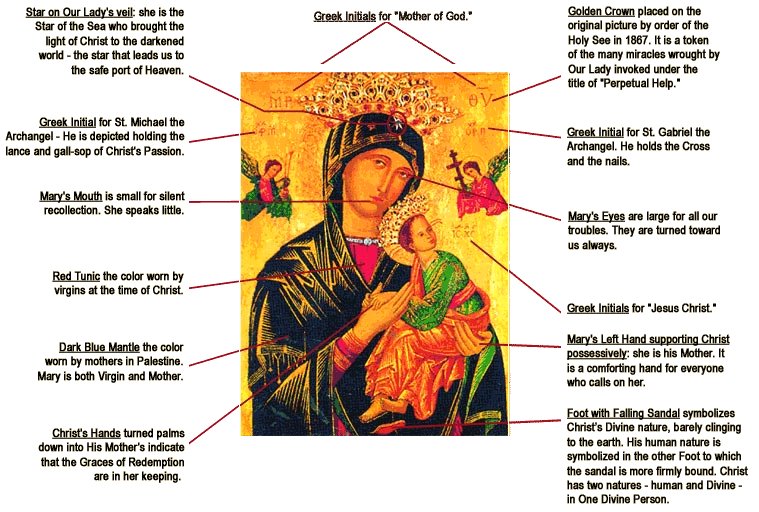
A guide to the most popular Marian icon in the Philippines

Ever since the Perpetual Novena to Our Lady of Perpetual Help began in Baclaran Church on June 23, 1948 (see the history of the Baclaran novena here), the icon of Our Lady of Perpetual Help has become, without a doubt, the most common icon of the Blessed Virgin Mary in the Philippines.


Thursday, June 21, 2012

For the record: Full text of Bishop Jesse Mercado's statement on the allegations published against him by the 'Rappler'

My initial commentary on the matter:

Even though the Philippine secular media has ignored the news of the selection of Cebu as the location of the International Eucharistic Congress in 2016, it has given full play to accusations of financial mismanagement against Bishop Jesse Mercado D.D., Ordinary of the Diocese of Paranaque. The accusations have been published on Rappler, an online news portal that is strongly believed in some Church circles to have an anti-Catholic bias, due in no little part to the negative news articles and scurrilous (if not idiotic) commentary against the Church that it has produced. From the Rappler the news has been spread with glee on the social networks especially by the new generation of Filipino atheists, agnostics and Church-haters. 

The original Rappler article: LINK
Follow-up Rappler article: LINK
Third Rappler article: LINK

I do not know if there is a truthful basis to these allegations and I hope that the Holy See will investigate the matter with firmness and promptness. I am all too aware that there are many situations within the Church in the Philippines that cry out for both earthly and heavenly justice. Nevertheless, the tone and language of the Rappler articles and their misuse by anti-Catholic elements in the Philippines cannot but raise the suspicion that there is more to this series of articles than the noble desire to expose wrongdoing and financial mismanagement for the sake of the common good.

***

Full text of Bishop Jesse Mercado's statement regarding the allegations published against him by the Rappler:


From the website of the Chancellery of the Diocese of Paranaque:


DOP CIRCULAR NO. 2012-034
20 June 2012

TO:


ALL PRIESTS, LAY LEADERS, AND PARISHIONERS OF THE DIOCESE OF PARAÑAQUE


RE:


OFFICIAL STATEMENT OF HIS EXCELLENCY, MOST REV. JESSE E. MERCADO, D.D.


Peace be with you!

In order to assure the People of God in the midst of this challenging time of purification, we issue this official statement. 

1.      All donations are properly receipted and promptly turned over to their intended beneficiaries. In urgent cases, e.g, Ondoy and Sendong, the Diocese even advanced the amounts even before the second collections were mandated. Some parishes remit too late, so these funds are added to the calamity fund. A detailed report is being prepared. All expenses are studied, reviewed and properly documented in the spirit of stewardship, transparency and accountability. The Diocese of Paranaque is audited annually by the Roman Catholic Archdiocese of Manila and receives a 100% rating. 

2.      The personal problems of priests are properly studied and treated by tempering justice with mercy. Priests who make mistakes but want to be helped are rehabilitated. Their reputation is protected. Nevertheless, this does not prevent some from undermining their own reputation by talking about their own situation as if they are being persecuted.

3.      The personal sharings of priests during meeting like the Ongoing Formation Seminar should be respected. To breach this confidentiality (usapang pari) is a betrayal of mutual respect and trust.

May the good Lord continue to guide and protect us in this trying moment of our journey.


+ JESSE E. MERCADO, D.D
Bishop of Paranaque
June 20, 2012


 Allegations and our Responses

1.      Donations not reaching intended beneficiaries. P3.2M diverted to diocesan fund and invested

Response:  Donations are regularly remitted to the intended beneficiaries. In urgent cases, e.g., Ondoy and Sendong, the Diocese even advanced the amounts even before the second collections were mandated. Some parishes remit too late, so these funds are added to the calamity fund.

The Muntinlupa fire victims were aided by the Vicariate. [When the Parish needs help, the Vicariate takes over. When the Vicariate needs help, the Diocese takes over.]

2.      Not funding social programs

Response:  Social programs are funded according to the budget policies of the diocese in order to avoid wastage of funds. Funds are thus usually released in tranches. Proper liquidation is required before new tranches are released precisely in order to ensure that the funds get to the intended beneficiaries.

3.      No money for programs

Response: There is money for programs. The funds are allocated only to projects that are worthwhile and only if they are positively recommended by their parish priests so that they are integrated into the parish program.

4.      P225,000 from PCSO stopped when Pres. Aquino came into power

Response: It was Bp. Jess who decided not to accept PCSO aid after the Senate probe on PCSO aid to Dioceses, so that government aid would not draw the Diocese into politics. It is the Diocese who now pays for the medicines for the poor formerly funded by the PCSO aid. The funds are taken from the Caritas Sunday collection.

5.      those who question financial management are either floated or replaced

a.      e.g. Muntinlupa parish priest who headed pastoral department removed as co-signatory of livelihood project for workers in Tunasan

Response: The Tunasan project was examined by the Parish Priest, who found irregularities. He therefore did not recommend it to the Bishop. However, who is the Muntinlupa parish priest mentioned by the author?

b.      five priests left the priesthood out of frustration and desperation

Response: Who are these priests? Those who left in the first 10 years of the Diocese left for personal reasons (e.g., sexual misconduct, fathering children).

c.      some have low morale and are thinking of leaving the priesthood

Response:  Why is their morale low? Bp. Jess and their fellow priests are always willing to help them.

d.      lay leaders who sought transparency are regarded as dissenters and are slowly being eased out of diocese' affairs.

Response:  Who are these lay leaders? No one is  being “eased out”.

6.      Quick to pardon priests who misappropriated Church funds, e.g., Msgr. Valenzuela – uncovered by Msgr. Gabriel in 2004. Instead of punishing Valenzuela however, Mercado simply terminated him as school director and barred him from having any assignments within the diocese. P10M declared uncollectible in October 2011. Msgr. Valenzuela allowed to resume his priestly duties in NY.

Response: The Diocese adopted many financial controls precisely because of incidences of bad investment, misappropriation, misrepresentation, etc.

Does Msgr. Valenzuela's termination, floating status and exile not constitute punishment? He is no longer entitled to pension and hospitalization. Is this not punishment?

The declaration of P10M as uncollectible was recommended by the audit of St. Andrew's School. After demanding for closure of the issue, why are they complaining that this closure was achieved?

On the distorted reporting on OGF sharing.

Response: The personal sharings of priests during meetings like the Ongoing Formation Seminar should be respected. To breach this confidentiality (usapang pari) is a betrayal of mutual respect and trust.

The personal problems of priests are being dealt with by balancing justice and mercy. Priests who make mistakes but want to be helped are rehabilitated. Their reputation is protected. Nevertheless, this does not prevent some from undermining their own reputation by talking about their own situation as if they are being persecuted.

Inaccuracies:

12% remitted by parishes, 1% for health insurance, 1% for retirement

10% estimated to be P15M

57 parishes

Response:  There are only 51 parishes, quasi-parish and national shrines in the Diocese. 10% of gross receipts of parishes are remitted to the Diocesan Fund of which majority is given to catechetical fund (c/o RCAM), investment for the retirement of priests, curia operations, clergy retreats, and clergy ongoing formation and outing. 2% of gross receipts go to the hospitalization and health services of priests.

Called mobile to no avail 

Response:  Aries Rufo contacted the Bishop's office in order to interview him about the Natural Family Planning program of the Diocese. He was of course referred to the Chairman of the Diocesan Commission on Family and Life. He never contacted the Chairman.

Tuesday, June 19, 2012

Snubbing a papal honor.

(Update: as of June 21, 2012, there is still little sign of this news on Philippine secular media outlets. Among major columnists for national dailies it seems to have been mentioned only by Valeriano "Bobit" Avila and Federico Pascual. Readers are free to tell me in the combox if I missed other columnists who have mentioned this as of today. Only a few newspapers have mentioned it in their news section, and then only in passing as part of a quote from Vice President Jejomar Binay regarding his upcoming visit to Rome. Even then, either these newspapers or the VP got the date wrong -- the event will be held in 2016, not 2015 -- an honest mistake, for sure.)

I find it interesting that, in the more than 24 hours after the news was announced in Dublin via a recorded papal message, the Philippine secular media has ignored the selection of Cebu as the site for the next International Eucharistic Congress, in 2016. (See my earlier blog post, Cebu to be the site of the 51st International Eucharistic Congress in 2016!)

I've been monitoring the websites of Philippine Daily Inquirer, Philippine Star, Manila Bulletin, ABS-CBN News, GMA News, and there is.... still nothing as of this moment (2:45 AM). If they have anything about the announcement, then it is so tiny and insignificant as to be very difficult to see, and I'm not a novice in navigating news websites. Even Cebuano news outlets such as The Freeman and Cebu Daily News seem to have nothing about the event. Either the Philippine secular media is extremely tardy about picking up news about their own country, or it doesn't care that the Pope has decided to bestow a signal honor upon the 'Queen City of the South'. Neither explanation brings much credit to Philippine journalism. 

I still remember how the Philippine media professed great respect for Pope John Paul II (despite their increasing disrespect for his moral teachings in the last 10 years of his life), and enthusiastically reported whenever a Philippine city would be selected for an international ecclesiastical gathering during the reign of the late Polish pontiff. Those times are long past, and I have no illusions about the level of respect that the Philippine media currently has for the Catholic Church (very little). However, this near-total boycott of the news astounds me; it would be unthinkable even in the West, where only two weeks ago the U.S.  and international media quickly reported Pope Benedict XVI's June 3 announcement that Philadelphia will be the next site of the World Meeting of Families, in 2015. 

The irony is that this snub comes just as the Cebuano media talks about the need for the Philippines to attract more visitors from abroad by the year... 2016! (See this article.) Perhaps religious pilgrims don't count?

Monday, June 18, 2012

Cebu to be the site of the 51st International Eucharistic Congress in 2016!

Pope Benedict XVI during Benediction with the Blessed Sacrament at the end of the Corpus Christi procession in Rome, June 7, 2012. Photo from Daylife


My dear brothers and sisters, I pray that the Congress will be for each of you a spiritually fruitful experience of communion with Christ and his Church. At the same time, I would like to invite you to join me in praying for God’s blessing upon the next International Eucharistic Congress, which will take place in 2016 in the city of Cebu! To the people of the Philippines I send warm greetings and an assurance of my closeness in prayer during the period of preparation for this great ecclesial gathering. I am confident that it will bring lasting spiritual renewal not only to them but to all the participants from across the globe. In the meantime, I commend everyone taking part in the present Congress to the loving protection of Mary, Mother of God, and to Saint Patrick, the great patron of Ireland; and, as a token of joy and peace in the Lord, I willingly impart my Apostolic Blessing.

There had been speculation since last year that the 51st IEC will be held in Cebu. See my blog post: Is the canonization of Blessed Pedro Calungsod at hand? And will Cebu be the site of the 51st International Eucharistic Congress?

Sunday, June 17, 2012

Vatican Radio on Archbishop Tagle's June 16 speech at the Int'l Eucharistic Congress in Dublin

Update: the full text of Archbishop Tagle's June 16, 2012 talk in Dublin can be found here: IEC Day 7 – Archbishop Luis Antonio Tagle: Communion in the Word through Mary

From the website of Vatican Radio:


In 2008 in Quebec, he had silenced a crowd of thousands with his words, in Dublin in 2012, he brought them to tears. On Saturday June 16th, the penultimate day of the 50th International Eucharistic Congress – Feast of the Immaculate Heart of Mary, the Archbishop of Manila, Luis Tagle, led reflections on the theme, Communion in the Word through Mary.

And he began with the ordinary human experience of establishing communion, a connection with others. He said, “We see in our time so much exchange of words happening at high speed and across national boundaries. But unfortunately the world is as divided as ever. Why is communion not achieved in spite of the exchange of words? Because Jesus is not the word they share and receive.”

The Saturday morning catechesis was the second time the Filipino Church leader, who will turn 55 later this month, addressed pilgrims here in Dublin. From the platform of the central arena his usually warm and reassuring voice cracked as his spoke of the very real consequences of a break down in human communion:

“When financial wizards talk about ways of manipulating the economy for their own profit, you do not call that communion; that is corruption! When politicians talk to people about grand promises without intending to fulfil them, you do not call that communion; that is cheating! When the powerful 'negotiate' among themselves while neglecting the weak, you do not call that communion; that is oppression! When so-called enterprising persons deal with each other on how women and children could be profitable merchandise, you do not call that communion; that is slavery!”

He concluded, “When communion consists in Jesus who is the Word of Life then the common good becomes central. And that is pleasing to God’s eyes.”

The Philippines and its beautiful shrines: a poster

From 100% Katolikong Pinoy on Facebook:

Please share to help our country's tourism industry through the beauty of our Catholic churches. God bless the Philippines!


Saturday, June 16, 2012

God is not mocked: The 33rd International Eucharistic Congress of 1937 in Manila and the fire that destroyed Tondo

The 33rd International Eucharistic Congress in Luneta Park, Manila (Feb. 3-7, 1937)
From a private collection. 

The attention of the universal Church is currently turned towards the 50th International Eucharistic Congress now taking place in Dublin, Ireland. I would like, therefore, to take this opportunity to recount a mysterious event that took place in Manila in 1937, the year the 33rd International Eucharistic Congress took place in Manila.

The following account comes from an extraordinary newsletter written by Fr. Lawrence Bunzel SVD and now held in the SVD Central Province's archives in Catholic Trade Manila. The letter is dated October 28, 1937, and was sent from Christ the King Missionary Seminary and addressed to the Friends of the SVD Missions in the Philippines. Emphases mine.


“Communism is trying to spread itself here of late. There is great danger that it may succeed, unless the government and the Church help to check it. It seems Divine Providence is helping us. Let me tell you of an incident which occurred this year. The nest of communism is here in a suburb of Manila which is called Tondo. When the Eucharistic Congress was held here last February the communists of Tondo told the people to boycott the Congress by not decorating their houses. The communists threatened to burn all houses that would be decorated. The people were afraid to decorate, except one family in the heart of the suburb. A few weeks after the Congress Tondo was almost completely destroyed by fire. During the blaze much ammunition and many bombs exploded. The peculiar thing about the fire was that the one house which was decorated during the Congress was spared, although it was in the midst of the burned district. No one could explain how it escaped destruction.”

Today, Tondo is arguably Metro Manila's most Catholic district; shrines to the Hesus Nazareno are everywhere and the annual celebration of its patronal feast (the feast of the Santo Niño held every third Sunday of January) sees massive religious processions and the arrival of millions of pilgrims.

"To pretend that no problem exists does not help." Archbishop Tagle's speech in Ireland regarding clergy sex abuse

The following is the speech of Archbishop Luis Antonio Tagle at the 50th International Eucharistic Congress in Dublin, Ireland, on June 12, 2012. (See this article.) The file below is taken from the USCCB website (link).

Archbishop Tagle will be the main speaker today, 16 June, at this Congress, which ends tomorrow. 

Reflections From Asia Tagle

Tuesday, April 17, 2012

Philippine edition of "Alive to the World" values education series published with the blessing of the CBCP

The following untitled media release is from the website of the Archdiocese of Lingayen-Dagupan:

The Episcopal Commission for Catechesis and Catholic Education (ECCCE) in collaboration with the Catholic Educational Association of the Philippines (CEAP) and Rex Publishing Company has launched a twelve-volume book series for children and youth entitled “Alive to the World”.

Centered on twelve books that can be used in or out of elementary and secondary school over as many years, this course presents an ongoing story about a group of friends who confront typical situations as they grow up. The program makes young people think about choices and consequences. At age appropriate levels, they have to consider family, friendship, peer pressure, romance, sex, love, marriage—and implications like loyalty, team work, personal responsibility, and respect for property, to name but a few.

 Over time, they learn that universal values make sense, that they form a coherent system, and, most importantly, that they open up a world of possibilities of health, happiness, and progress.

This book series on personal, social and health education has been tested successfully in Latin America, the United States and the United Kingdom.

Archbishop Socrates B Villegas, the chairman of the Episcopal Commission for Catechesis and Catholic Education “admits that this is a pro active response to the steady deterioration of Catholic values among our youth. The Church is not an “anti” institution. The Church is a teacher and caretaker of truly positive universal human and Christian values. The way to overcome the anti-family and anti-life bills in congress is to teach our youth and children what are truly human and Christian values.”

The books teach about sex and family in an age appropriate manner and using universal human values. Even non Christians can benefit from this book series.

“We will fight the anti-life and anti-family and anti-women bills in Congress by winning the minds and hearts of our youth. We will overcome these evil bills by the power of good, dedicated and well formed young leaders. The hope of the nation is the pro-family pro-life youth not the anti-life and anti-family congressmen.”

“I encourage all our Catholic universities, colleges and schools to avail of the book series from Rex Publishing Company and start using the series when the school year opens in June. It has a series for students and another series for teachers to assist them in the classroom instruction.”

"Alive to the World" was originally designed and produced in Spanish by Christine de Marcellus Vollmer, a member of the Pontifical Council for the Family and the Pontifical Academy for Life. It is currently being promoted internationally by Alliance for the Family and has been widely distributed (in adapted form) in South America and in Sub-Saharan Africa

More information on this program can be found in the Alive to the World UK website and in the following article by Zenit: VALUES-BASED SEX ED APPEALS TO HEAD, HEART - "Alive to the World" Program Called an Effective Alternative

Mercator.Net also has the following laudatory article on this program: Alive to the World: a character education programme that works

The Zenit article mentions that this program has enjoyed the support of the late Alfonso Cardinal López Trujillo and his successor as President of the Pontifical Council for the Family, Ennio Cardinal Antonelli. 

The following is the promotional video for 'Alive to the World' in the United Kingdom:

Sunday, April 8, 2012

Monday, April 2, 2012

The tears of Cardinal Sanchez

Cardinal Sanchez celebrating Mass. Source
What I admire most about Cardinal Sanchez was his deep reverence towards the sacred liturgy. Despite the certain limitations of his body, he would somehow find that inner strength and force his body to function properly just for him to be able to express the proper reverence ought to be given. At his age, he would forcefully genuflect when passing the tabernacle and during the consecration and he would even bow whenever Jesus Christ, Mother Mary and the Holy Trinity is mentioned. But what strikes me the most is that this man cries during the consecration at every mass. Such passion, love and commitment can only be read in books on the lives of saints and martyrs, yet I was one of the lucky ones, despite my unworthiness, to have witness such holiness and purity.
 ~ Testimony of Leopoldo Eduardo Nievera II (Cardinal Sanchez's "unofficial official photographer") on his blog, "Profratribus" (from the post "Discovering Cardinal Sanchez through my camera lens", March 11, 2012)

...He so identified with the suffering and passion of our Lord that many times during Mass, which he always celebrated with great solemnity, his eyes would fill with tears, his voice crack and tremble, as he pronounced the words of consecration and he would have to pause long and hard to regain control of his emotions before he could go on. 

~ CBCP Monitor, Editorial (p. A4), March 12 - 25, 2012, Vol. 16. No. 6. 

Jose Cardinal Sanchez was a man truly in love with God and with His Church. Although he was noted for his earnest demeanor, he was in reality a person very much in touch with his feelings. But while emotional men may cry over painful and sad events, Cardinal Sanchez sheds tears at the consecration of every mass. 
It may confound some observers, why his voice cracks as he pronounces the words of consecration. But Cardinal Sanchez was invariably moved by the tremendous reality that takes place at every Eucharistic celebration, when bread and wine turn into the Body and Blood of the Lord.  
He was a man of profound faith. Only the man who sees with the eyes of faith can appreciate the profound mystery of the Eucharist. This faith founds him on the solid rock of certitude, a quality not too many people possess today...

~ From Ricardo Cardinal Vidal's homily at the funeral of Jose Cardinal Sanchez. (Front page, CBCP Monitor, March 12 - 25, 2012, Vol. 16. No. 6.)