Wednesday, July 4, 2012

A truly Catholic statesman

Hilario G. Davide Jr., Chief Justice of the Philippines from November 30, 1998 to December 20, 2005, is an example of that once-common but now dying breed of Filipino statesmen for whom Catholicism is the defining source of guidance not just for private life, but also for life in the public square. He represents a tradition now seriously threatened by the militant secularism that is increasingly pervading the Philippine political and social establishment. 

He was second to the last in the line of openly and proudly Catholic Chief Justices who headed the Philippine judiciary from the time of Pres. Corazon Aquino until the retirement of Chief Justice Artemio Panganiban in 2006. 

Whatever one might think of his actions regarding the "Edsa People Power II" revolution in 2001, there is no denying his fidelity to his Catholic convictions. One of my fondest memories of him, is of him leading the Philippine Senate in singing the Catholic Church in the Philippines' "Jubilee Song" (for the Great Jubilee of 2000) at the end of the last day of the Senate impeachment trial of then-President Joseph Estrada for the month of December, in the year 2000. 

The following passage is taken from an interview with him published yesterday by the American Catholic magazine, the National Catholic Register: Philippines' Constitutional Framer: More People, More Glory to God.


Talk about the People Power revolution of 1986.

These were turbulent times for the Philippines, times of oppression and injustice for the people due to the dictatorial regime of Marcos.

The leader of the opposition was Ninoy Aquino, who was exiled by Marcos and lived in America. When he returned in August 1983, he was shot and killed right on the tarmac of the airport. Many others were victims of persecution, many died, but we were empowered by the death of our icon, Ninoy Aquino, which galvanized opposition to Marcos. …

Then, in 1986, Marcos called a snap election, and there were so many irregularities, and we knew that Marcos won because of cheating and fraudulent reports. We believed that our opposition candidate, Cory Aquino, the wife of our slain leader, had actually won. This led to massive street demonstrations and the ouster of Marcos, and she was proclaimed president.

I was no longer in government at the time; my term had ended in 1984, and I was back home in Cebu. But when she called the constitutional commission of 1986, I was one of the 50 selected to draft the 1987 Constitution of the Philippines. I was chairman of the legislative committee that formulated the power of the legislative body, and I was a member of other committees. We did our best.

You have said that you are proud that the word “love” is in the preamble.

Yes, our preamble is, I think, the best of any preamble of all the countries in the world because it mentions the word “love.” We ask for “the blessings of independence and democracy under the rule of law and a regime of truth, justice, freedom, love, equality and peace.” The preamble is a prayer, asking the Almighty to help the sovereign Filipino people to establish a just and humane society and a government that embodies our ideals, hopes and aspirations.

A scene from the 1986 EDSA Revolution.
Source

Do you think that the bloodless People Power revolution paved the way for Eastern Europe to throw off communism three years later?

Yes, definitely; it became, really, the light of the succeeding events of our country and the guide for many of our people — and for many other people of the world in the years to come.

The Philippines stands out as the only nation, besides the Vatican, to prohibit divorce.

Our constitution prohibits divorce and abortion. We are anti-divorce, anti-abortion; we are pro-life, pro-family and pro-marriage under the constitution. The right to life of the unborn from the moment of conception is in the Bill of Rights. But, unfortunately, at one time, the Philippine legislature enacted a bill providing for the implementation of the death penalty for some heinous crimes; but it was repealed much later because it reflected badly on the Philippines, especially among the Catholics.

Has your Catholic faith guided your public service?

I would attribute what I have accomplished to my Catholic faith. I have full confidence in the providence of God. We are told by Jesus how to love our neighbors, and we have to do unto others as we would have them do unto us. It is only by the grace of God that you can say that your life has been fulfilled. Even in our family, our children and our grandchildren are brought up being taught how to pursue this life of faith and service to others.

What do you see as the future of the Philippines, which is often called poor and overpopulated?

I am very hopeful for the Philippines and her people. In a recent survey by the University of Chicago, it was demonstrated that, of all the peoples of the world, the Philippines has the greatest level of belief in God. The people’s faith in divine Providence has sustained them, in time of calamity, in time of adversity. So you can see the Filipino people as the most “smiling” in the world. … Even with rising population, this is no problem in my view. We will have more workers, more people and families to work for the greater glory of God.

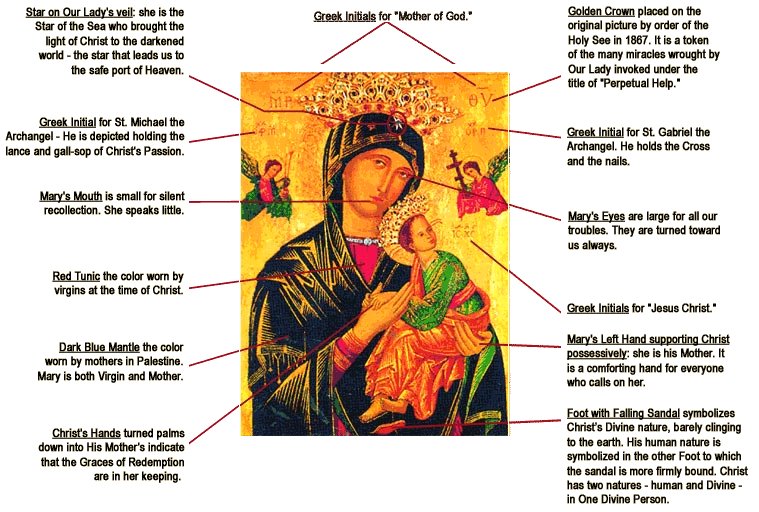
Wednesday, June 27, 2012

A guide to the most popular Marian icon in the Philippines

Ever since the Perpetual Novena to Our Lady of Perpetual Help began in Baclaran Church on June 23, 1948 (see the history of the Baclaran novena here), the icon of Our Lady of Perpetual Help has become, without a doubt, the most common icon of the Blessed Virgin Mary in the Philippines.


Thursday, June 21, 2012

For the record: Full text of Bishop Jesse Mercado's statement on the allegations published against him by the 'Rappler'

My initial commentary on the matter:

Even though the Philippine secular media has ignored the news of the selection of Cebu as the location of the International Eucharistic Congress in 2016, it has given full play to accusations of financial mismanagement against Bishop Jesse Mercado D.D., Ordinary of the Diocese of Paranaque. The accusations have been published on Rappler, an online news portal that is strongly believed in some Church circles to have an anti-Catholic bias, due in no little part to the negative news articles and scurrilous (if not idiotic) commentary against the Church that it has produced. From the Rappler the news has been spread with glee on the social networks especially by the new generation of Filipino atheists, agnostics and Church-haters. 

The original Rappler article: LINK
Follow-up Rappler article: LINK
Third Rappler article: LINK

I do not know if there is a truthful basis to these allegations and I hope that the Holy See will investigate the matter with firmness and promptness. I am all too aware that there are many situations within the Church in the Philippines that cry out for both earthly and heavenly justice. Nevertheless, the tone and language of the Rappler articles and their misuse by anti-Catholic elements in the Philippines cannot but raise the suspicion that there is more to this series of articles than the noble desire to expose wrongdoing and financial mismanagement for the sake of the common good.

***

Full text of Bishop Jesse Mercado's statement regarding the allegations published against him by the Rappler:


From the website of the Chancellery of the Diocese of Paranaque:


DOP CIRCULAR NO. 2012-034
20 June 2012

TO:


ALL PRIESTS, LAY LEADERS, AND PARISHIONERS OF THE DIOCESE OF PARAÑAQUE


RE:


OFFICIAL STATEMENT OF HIS EXCELLENCY, MOST REV. JESSE E. MERCADO, D.D.


Peace be with you!

In order to assure the People of God in the midst of this challenging time of purification, we issue this official statement. 

1.      All donations are properly receipted and promptly turned over to their intended beneficiaries. In urgent cases, e.g, Ondoy and Sendong, the Diocese even advanced the amounts even before the second collections were mandated. Some parishes remit too late, so these funds are added to the calamity fund. A detailed report is being prepared. All expenses are studied, reviewed and properly documented in the spirit of stewardship, transparency and accountability. The Diocese of Paranaque is audited annually by the Roman Catholic Archdiocese of Manila and receives a 100% rating. 

2.      The personal problems of priests are properly studied and treated by tempering justice with mercy. Priests who make mistakes but want to be helped are rehabilitated. Their reputation is protected. Nevertheless, this does not prevent some from undermining their own reputation by talking about their own situation as if they are being persecuted.

3.      The personal sharings of priests during meeting like the Ongoing Formation Seminar should be respected. To breach this confidentiality (usapang pari) is a betrayal of mutual respect and trust.

May the good Lord continue to guide and protect us in this trying moment of our journey.


+ JESSE E. MERCADO, D.D
Bishop of Paranaque
June 20, 2012


 Allegations and our Responses

1.      Donations not reaching intended beneficiaries. P3.2M diverted to diocesan fund and invested

Response:  Donations are regularly remitted to the intended beneficiaries. In urgent cases, e.g., Ondoy and Sendong, the Diocese even advanced the amounts even before the second collections were mandated. Some parishes remit too late, so these funds are added to the calamity fund.

The Muntinlupa fire victims were aided by the Vicariate. [When the Parish needs help, the Vicariate takes over. When the Vicariate needs help, the Diocese takes over.]

2.      Not funding social programs

Response:  Social programs are funded according to the budget policies of the diocese in order to avoid wastage of funds. Funds are thus usually released in tranches. Proper liquidation is required before new tranches are released precisely in order to ensure that the funds get to the intended beneficiaries.

3.      No money for programs

Response: There is money for programs. The funds are allocated only to projects that are worthwhile and only if they are positively recommended by their parish priests so that they are integrated into the parish program.

4.      P225,000 from PCSO stopped when Pres. Aquino came into power

Response: It was Bp. Jess who decided not to accept PCSO aid after the Senate probe on PCSO aid to Dioceses, so that government aid would not draw the Diocese into politics. It is the Diocese who now pays for the medicines for the poor formerly funded by the PCSO aid. The funds are taken from the Caritas Sunday collection.

5.      those who question financial management are either floated or replaced

a.      e.g. Muntinlupa parish priest who headed pastoral department removed as co-signatory of livelihood project for workers in Tunasan

Response: The Tunasan project was examined by the Parish Priest, who found irregularities. He therefore did not recommend it to the Bishop. However, who is the Muntinlupa parish priest mentioned by the author?

b.      five priests left the priesthood out of frustration and desperation

Response: Who are these priests? Those who left in the first 10 years of the Diocese left for personal reasons (e.g., sexual misconduct, fathering children).

c.      some have low morale and are thinking of leaving the priesthood

Response:  Why is their morale low? Bp. Jess and their fellow priests are always willing to help them.

d.      lay leaders who sought transparency are regarded as dissenters and are slowly being eased out of diocese' affairs.

Response:  Who are these lay leaders? No one is  being “eased out”.

6.      Quick to pardon priests who misappropriated Church funds, e.g., Msgr. Valenzuela – uncovered by Msgr. Gabriel in 2004. Instead of punishing Valenzuela however, Mercado simply terminated him as school director and barred him from having any assignments within the diocese. P10M declared uncollectible in October 2011. Msgr. Valenzuela allowed to resume his priestly duties in NY.

Response: The Diocese adopted many financial controls precisely because of incidences of bad investment, misappropriation, misrepresentation, etc.

Does Msgr. Valenzuela's termination, floating status and exile not constitute punishment? He is no longer entitled to pension and hospitalization. Is this not punishment?

The declaration of P10M as uncollectible was recommended by the audit of St. Andrew's School. After demanding for closure of the issue, why are they complaining that this closure was achieved?

On the distorted reporting on OGF sharing.

Response: The personal sharings of priests during meetings like the Ongoing Formation Seminar should be respected. To breach this confidentiality (usapang pari) is a betrayal of mutual respect and trust.

The personal problems of priests are being dealt with by balancing justice and mercy. Priests who make mistakes but want to be helped are rehabilitated. Their reputation is protected. Nevertheless, this does not prevent some from undermining their own reputation by talking about their own situation as if they are being persecuted.

Inaccuracies:

12% remitted by parishes, 1% for health insurance, 1% for retirement

10% estimated to be P15M

57 parishes

Response:  There are only 51 parishes, quasi-parish and national shrines in the Diocese. 10% of gross receipts of parishes are remitted to the Diocesan Fund of which majority is given to catechetical fund (c/o RCAM), investment for the retirement of priests, curia operations, clergy retreats, and clergy ongoing formation and outing. 2% of gross receipts go to the hospitalization and health services of priests.

Called mobile to no avail 

Response:  Aries Rufo contacted the Bishop's office in order to interview him about the Natural Family Planning program of the Diocese. He was of course referred to the Chairman of the Diocesan Commission on Family and Life. He never contacted the Chairman.

Tuesday, June 19, 2012

Snubbing a papal honor.

(Update: as of June 21, 2012, there is still little sign of this news on Philippine secular media outlets. Among major columnists for national dailies it seems to have been mentioned only by Valeriano "Bobit" Avila and Federico Pascual. Readers are free to tell me in the combox if I missed other columnists who have mentioned this as of today. Only a few newspapers have mentioned it in their news section, and then only in passing as part of a quote from Vice President Jejomar Binay regarding his upcoming visit to Rome. Even then, either these newspapers or the VP got the date wrong -- the event will be held in 2016, not 2015 -- an honest mistake, for sure.)

I find it interesting that, in the more than 24 hours after the news was announced in Dublin via a recorded papal message, the Philippine secular media has ignored the selection of Cebu as the site for the next International Eucharistic Congress, in 2016. (See my earlier blog post, Cebu to be the site of the 51st International Eucharistic Congress in 2016!)

I've been monitoring the websites of Philippine Daily Inquirer, Philippine Star, Manila Bulletin, ABS-CBN News, GMA News, and there is.... still nothing as of this moment (2:45 AM). If they have anything about the announcement, then it is so tiny and insignificant as to be very difficult to see, and I'm not a novice in navigating news websites. Even Cebuano news outlets such as The Freeman and Cebu Daily News seem to have nothing about the event. Either the Philippine secular media is extremely tardy about picking up news about their own country, or it doesn't care that the Pope has decided to bestow a signal honor upon the 'Queen City of the South'. Neither explanation brings much credit to Philippine journalism. 

I still remember how the Philippine media professed great respect for Pope John Paul II (despite their increasing disrespect for his moral teachings in the last 10 years of his life), and enthusiastically reported whenever a Philippine city would be selected for an international ecclesiastical gathering during the reign of the late Polish pontiff. Those times are long past, and I have no illusions about the level of respect that the Philippine media currently has for the Catholic Church (very little). However, this near-total boycott of the news astounds me; it would be unthinkable even in the West, where only two weeks ago the U.S.  and international media quickly reported Pope Benedict XVI's June 3 announcement that Philadelphia will be the next site of the World Meeting of Families, in 2015. 

The irony is that this snub comes just as the Cebuano media talks about the need for the Philippines to attract more visitors from abroad by the year... 2016! (See this article.) Perhaps religious pilgrims don't count?

Monday, June 18, 2012

Cebu to be the site of the 51st International Eucharistic Congress in 2016!

Pope Benedict XVI during Benediction with the Blessed Sacrament at the end of the Corpus Christi procession in Rome, June 7, 2012. Photo from Daylife


My dear brothers and sisters, I pray that the Congress will be for each of you a spiritually fruitful experience of communion with Christ and his Church. At the same time, I would like to invite you to join me in praying for God’s blessing upon the next International Eucharistic Congress, which will take place in 2016 in the city of Cebu! To the people of the Philippines I send warm greetings and an assurance of my closeness in prayer during the period of preparation for this great ecclesial gathering. I am confident that it will bring lasting spiritual renewal not only to them but to all the participants from across the globe. In the meantime, I commend everyone taking part in the present Congress to the loving protection of Mary, Mother of God, and to Saint Patrick, the great patron of Ireland; and, as a token of joy and peace in the Lord, I willingly impart my Apostolic Blessing.

There had been speculation since last year that the 51st IEC will be held in Cebu. See my blog post: Is the canonization of Blessed Pedro Calungsod at hand? And will Cebu be the site of the 51st International Eucharistic Congress?

Sunday, June 17, 2012

Vatican Radio on Archbishop Tagle's June 16 speech at the Int'l Eucharistic Congress in Dublin

Update: the full text of Archbishop Tagle's June 16, 2012 talk in Dublin can be found here: IEC Day 7 – Archbishop Luis Antonio Tagle: Communion in the Word through Mary

From the website of Vatican Radio:


In 2008 in Quebec, he had silenced a crowd of thousands with his words, in Dublin in 2012, he brought them to tears. On Saturday June 16th, the penultimate day of the 50th International Eucharistic Congress – Feast of the Immaculate Heart of Mary, the Archbishop of Manila, Luis Tagle, led reflections on the theme, Communion in the Word through Mary.

And he began with the ordinary human experience of establishing communion, a connection with others. He said, “We see in our time so much exchange of words happening at high speed and across national boundaries. But unfortunately the world is as divided as ever. Why is communion not achieved in spite of the exchange of words? Because Jesus is not the word they share and receive.”

The Saturday morning catechesis was the second time the Filipino Church leader, who will turn 55 later this month, addressed pilgrims here in Dublin. From the platform of the central arena his usually warm and reassuring voice cracked as his spoke of the very real consequences of a break down in human communion:

“When financial wizards talk about ways of manipulating the economy for their own profit, you do not call that communion; that is corruption! When politicians talk to people about grand promises without intending to fulfil them, you do not call that communion; that is cheating! When the powerful 'negotiate' among themselves while neglecting the weak, you do not call that communion; that is oppression! When so-called enterprising persons deal with each other on how women and children could be profitable merchandise, you do not call that communion; that is slavery!”

He concluded, “When communion consists in Jesus who is the Word of Life then the common good becomes central. And that is pleasing to God’s eyes.”

The Philippines and its beautiful shrines: a poster

From 100% Katolikong Pinoy on Facebook:

Please share to help our country's tourism industry through the beauty of our Catholic churches. God bless the Philippines!


Saturday, June 16, 2012

God is not mocked: The 33rd International Eucharistic Congress of 1937 in Manila and the fire that destroyed Tondo

The 33rd International Eucharistic Congress in Luneta Park, Manila (Feb. 3-7, 1937)
From a private collection. 

The attention of the universal Church is currently turned towards the 50th International Eucharistic Congress now taking place in Dublin, Ireland. I would like, therefore, to take this opportunity to recount a mysterious event that took place in Manila in 1937, the year the 33rd International Eucharistic Congress took place in Manila.

The following account comes from an extraordinary newsletter written by Fr. Lawrence Bunzel SVD and now held in the SVD Central Province's archives in Catholic Trade Manila. The letter is dated October 28, 1937, and was sent from Christ the King Missionary Seminary and addressed to the Friends of the SVD Missions in the Philippines. Emphases mine.


“Communism is trying to spread itself here of late. There is great danger that it may succeed, unless the government and the Church help to check it. It seems Divine Providence is helping us. Let me tell you of an incident which occurred this year. The nest of communism is here in a suburb of Manila which is called Tondo. When the Eucharistic Congress was held here last February the communists of Tondo told the people to boycott the Congress by not decorating their houses. The communists threatened to burn all houses that would be decorated. The people were afraid to decorate, except one family in the heart of the suburb. A few weeks after the Congress Tondo was almost completely destroyed by fire. During the blaze much ammunition and many bombs exploded. The peculiar thing about the fire was that the one house which was decorated during the Congress was spared, although it was in the midst of the burned district. No one could explain how it escaped destruction.”

Today, Tondo is arguably Metro Manila's most Catholic district; shrines to the Hesus Nazareno are everywhere and the annual celebration of its patronal feast (the feast of the Santo Niño held every third Sunday of January) sees massive religious processions and the arrival of millions of pilgrims.

"To pretend that no problem exists does not help." Archbishop Tagle's speech in Ireland regarding clergy sex abuse

The following is the speech of Archbishop Luis Antonio Tagle at the 50th International Eucharistic Congress in Dublin, Ireland, on June 12, 2012. (See this article.) The file below is taken from the USCCB website (link).

Archbishop Tagle will be the main speaker today, 16 June, at this Congress, which ends tomorrow. 

Reflections From Asia Tagle

Tuesday, April 17, 2012

Philippine edition of "Alive to the World" values education series published with the blessing of the CBCP

The following untitled media release is from the website of the Archdiocese of Lingayen-Dagupan:

The Episcopal Commission for Catechesis and Catholic Education (ECCCE) in collaboration with the Catholic Educational Association of the Philippines (CEAP) and Rex Publishing Company has launched a twelve-volume book series for children and youth entitled “Alive to the World”.

Centered on twelve books that can be used in or out of elementary and secondary school over as many years, this course presents an ongoing story about a group of friends who confront typical situations as they grow up. The program makes young people think about choices and consequences. At age appropriate levels, they have to consider family, friendship, peer pressure, romance, sex, love, marriage—and implications like loyalty, team work, personal responsibility, and respect for property, to name but a few.

 Over time, they learn that universal values make sense, that they form a coherent system, and, most importantly, that they open up a world of possibilities of health, happiness, and progress.

This book series on personal, social and health education has been tested successfully in Latin America, the United States and the United Kingdom.

Archbishop Socrates B Villegas, the chairman of the Episcopal Commission for Catechesis and Catholic Education “admits that this is a pro active response to the steady deterioration of Catholic values among our youth. The Church is not an “anti” institution. The Church is a teacher and caretaker of truly positive universal human and Christian values. The way to overcome the anti-family and anti-life bills in congress is to teach our youth and children what are truly human and Christian values.”

The books teach about sex and family in an age appropriate manner and using universal human values. Even non Christians can benefit from this book series.

“We will fight the anti-life and anti-family and anti-women bills in Congress by winning the minds and hearts of our youth. We will overcome these evil bills by the power of good, dedicated and well formed young leaders. The hope of the nation is the pro-family pro-life youth not the anti-life and anti-family congressmen.”

“I encourage all our Catholic universities, colleges and schools to avail of the book series from Rex Publishing Company and start using the series when the school year opens in June. It has a series for students and another series for teachers to assist them in the classroom instruction.”

"Alive to the World" was originally designed and produced in Spanish by Christine de Marcellus Vollmer, a member of the Pontifical Council for the Family and the Pontifical Academy for Life. It is currently being promoted internationally by Alliance for the Family and has been widely distributed (in adapted form) in South America and in Sub-Saharan Africa

More information on this program can be found in the Alive to the World UK website and in the following article by Zenit: VALUES-BASED SEX ED APPEALS TO HEAD, HEART - "Alive to the World" Program Called an Effective Alternative

Mercator.Net also has the following laudatory article on this program: Alive to the World: a character education programme that works

The Zenit article mentions that this program has enjoyed the support of the late Alfonso Cardinal López Trujillo and his successor as President of the Pontifical Council for the Family, Ennio Cardinal Antonelli. 

The following is the promotional video for 'Alive to the World' in the United Kingdom:

Sunday, April 8, 2012

Monday, April 2, 2012

The tears of Cardinal Sanchez

Cardinal Sanchez celebrating Mass. Source
What I admire most about Cardinal Sanchez was his deep reverence towards the sacred liturgy. Despite the certain limitations of his body, he would somehow find that inner strength and force his body to function properly just for him to be able to express the proper reverence ought to be given. At his age, he would forcefully genuflect when passing the tabernacle and during the consecration and he would even bow whenever Jesus Christ, Mother Mary and the Holy Trinity is mentioned. But what strikes me the most is that this man cries during the consecration at every mass. Such passion, love and commitment can only be read in books on the lives of saints and martyrs, yet I was one of the lucky ones, despite my unworthiness, to have witness such holiness and purity.
 ~ Testimony of Leopoldo Eduardo Nievera II (Cardinal Sanchez's "unofficial official photographer") on his blog, "Profratribus" (from the post "Discovering Cardinal Sanchez through my camera lens", March 11, 2012)

...He so identified with the suffering and passion of our Lord that many times during Mass, which he always celebrated with great solemnity, his eyes would fill with tears, his voice crack and tremble, as he pronounced the words of consecration and he would have to pause long and hard to regain control of his emotions before he could go on. 

~ CBCP Monitor, Editorial (p. A4), March 12 - 25, 2012, Vol. 16. No. 6. 

Jose Cardinal Sanchez was a man truly in love with God and with His Church. Although he was noted for his earnest demeanor, he was in reality a person very much in touch with his feelings. But while emotional men may cry over painful and sad events, Cardinal Sanchez sheds tears at the consecration of every mass. 
It may confound some observers, why his voice cracks as he pronounces the words of consecration. But Cardinal Sanchez was invariably moved by the tremendous reality that takes place at every Eucharistic celebration, when bread and wine turn into the Body and Blood of the Lord.  
He was a man of profound faith. Only the man who sees with the eyes of faith can appreciate the profound mystery of the Eucharist. This faith founds him on the solid rock of certitude, a quality not too many people possess today...

~ From Ricardo Cardinal Vidal's homily at the funeral of Jose Cardinal Sanchez. (Front page, CBCP Monitor, March 12 - 25, 2012, Vol. 16. No. 6.)

Wednesday, March 28, 2012

Passiontide veiling in the Philippines (updated post)

Prior to the introduction of the Missal of Pope Paul VI (popularly known as the "Novus Ordo" or "Forma Ordinaria" / Ordinary Form of the Roman Rite) in late 1969, the Roman Rite had the practice of veiling all (or most) of the crosses and images in churches during "Passiontide", which began with the Fifth Sunday of Lent (known in the Roman Rite as "Passion Sunday" until 1960 and as the "First Sunday of the Passion" from 1960 until 1969) and ended with Holy Saturday. This practice is still retained in many churches abroad (even those that use the Missal of Paul VI exclusively), as well as in the churches and oratories where the pre-Conciliar Roman Rite is followed. It is not required, but encouraged. 

In the Philippines, at least in my experience, churches in the Metro Manila area normally veil their images only beginning with Palm Sunday. Some do so only for the Triduum, and I've gone to one major parish (which I shall not name here, out of charity) where the veils are used only on Good Friday. I've also heard from a number of friends that some Metro Manila parishes never veil their images at any time during Passiontide. On the other hand, some parishes veil their images as early as Ash Wednesday. 

At any rate, there are at least two cathedrals in Metro Manila that follow the Roman Rite's historic tradition in this regard, namely, the Immaculate Conception Cathedral of the Diocese of Pasig and the San Roque Cathedral of the Diocese of Caloocan, which have veiled their images since this past Sunday (March 25, the Fifth Sunday of Lent):

Immaculate Conception Cathedral of the Diocese of Pasig


San Roque Cathedral of the Diocese of Caloocan

(H/t to Kristoffer Balazuela for the picture of Immaculate Conception Cathedral and to Noah Acha for the picture of San Roque Cathedral.)


***


Observation # 1 (March 31, 2012): Today I visited 7 churches in central Batangas. None had veiled images.

Observation #2 (April 5, 2012): According to a friend of mine, the Cathedral of the Diocese of San Pablo and the Catholic parish in Los Banos veiled their images today, Holy Thursday.  

Tuesday, March 27, 2012

Solemn Pontifical Mass according to the 1962 Missal in Cebu

The blog of the Societas Ecclesia Dei Sancti Joseph has published several photos of the Solemn Pontifical Mass celebrated yesterday (March 26, 2012) by Msgr. Jose Palma D.D., Archbishop of Cebu.

Thursday, March 22, 2012

Fresh graduates urged to volunteer for Church work while awaiting employment

From CBCP News:
Unemployed fresh grads urged to work for the Church 
MANILA, March 21, 2012—Administrators of Catholic schools, colleges and universities nationwide are encouraging their graduates to render volunteer work for their parishes while awaiting employment. 
Fr. Gregg Bañaga Jr., CM of the Catholic Educational Association of the Philippines (CEAP) invited fresh graduates to consider working as a volunteer for the Church especially if they will be unemployed. 
“Volunteering for parish work is a worthwhile activity during the summer break and also while one is still unemployed,” he said. 
Bañaga made the suggestion after government reportedly expects thousands of students to graduate this month as the school year ends. The fresh graduates are unfortunate to add to the growing statistics of unemployed Filipinos due to scarcity of job opportunities. 
Although volunteering for parish work may not be a money-making venture for fresh graduates, it is nevertheless an opportunity to serve the Church especially for Catholic school-raised students, according to Bañaga. 
The priest, who is the president of Adamson University, also encouraged fresh graduates to take some time to rest from schoolwork before getting employed. 
“I advise them to take rest first before looking for jobs. Their vacation can also be a time for them to rest and think more deeply about their plans in life,” he said. 
Earlier, Legazpi Bishop Joel Baylon advised students and graduates to spend some time for spiritual recollection during their summer break so as to have meaningful observance of Lent. 
Baylon, who chairs the CBCP Episcopal Commission on Youth, also invited the young faithful to gather their friends and attend together summer camps and leadership conferences being organized by the parishes near them and youth organizations in their community to make their summer vacation more meaningful. 
“While it is great to be with friends on vacation, it is also fulfilling to be with them in attending summer camps, youth conferences or Bible study classes, which are alternative activities this summer where they can even learn a lot from,” he added. (YouthPinoy)

Friday, March 16, 2012

Felipe Songson: When will he be beatified?

Blessed Pedro Calungsod, martyred in Guam in 1672, is now on his way to a definitive place on the altars of the Catholic Church. However, he is not the only Filipino to have been suffered for the Catholic faith in that island. This blog post is dedicated to another such witness for the faith: the Macabebe aristocrat and Jesuit donado Felipe Sonson (also spelled Songsong), who faithfully and devoutly served with Jesuit missionaries in Guam for almost 18 years, finally dying in 1685 after being seriously wounded in an attack that was brought about by hatred for the Catholic faith.

San Nicolas de Tolentino Church, Macabebe, Pampanga. Source.

Posted below are two readings regarding Felipe Sonson. 

1) The following passage regarding Sonson -- reproduced on this blog post without its footnotes --  is from pp. 281 - 282 of the article of Fr. John Schumacher SJ, "Early Filipino Jesuits" [Philippine Studies 29 (1981) pp. 271 - 308.]

"...Felipe Sonson of Pampanga ... was among the members of the Jesuit mission in the Marianas who were killed by the natives in 1684. (He actually died in 1685. See the Tantingco article below. CAP.) He is mentioned several times in a series of documents listed in the Maggs Brothers Catalogue no. 442, most of them letters from various Jesuits to the Duchess of Aveiro, great benefactress of the Marianas mission (...) A letter of 30 May 1686 to the Duchess by Fr. Lorenzo Bustillo, S.J., is reported as describing "the martyrdom of Padres Pedro Canaano and Pabon [sic], and the death of Padre [sic] Pelippe [sic] Sonson, a native of Pampanga 'whose solid virtues were an example to his countrymen, and who, being a noble among his own people, is now, we believe, from his blameless life, a most noble citizen of the Realm of Heaven.'" A letter of Fr. Antonio Zerezo to Fr. Balthasar de Mansilla, dated in Agadna [Agaña], Guam, 17 May 1686, is quoted as saying: "We have also learnt of the death of the saintly Philippine, Filipe [sic] Sonson...." Finally, a note of the Duchess of Aveiro from about 1686 to Fr. Luis Morals, S.J., written on the back of a list of martyrs, says she is returning it 'because I think that of the five or six martyrs and the good Sonson we can make a report which I shall have printed." The compiler notes after the name of Sonson that he was "a native Catholic who perished with the Padres." The list itself contains the names of four priests and Bro. Pavon (a Spaniard), not that of Sonson. From these contradictory annotations and partial quotations, a series of questions arises: was Sonson a Filipino? was he a Jesuit or not? And if a Jesuit, was he a priest or a brother?

He was in fact a Filipino from Macabebe, Pampanga. Fr. Pedro Murillo Velarde speaks of him as an "Indio Philipino" who was attacked by the Guamanians together with Bro. Pavon. He does not, however, give him the title of either Padre or Hermano, a fact which is also true in both the direct quotations from letters given above (as distinct from the annotations of the cataloger). He was rather a donado, as is explicitly noted after his name in the manuscript Jesuit catalog of personnel in the Marianas mission in 1681 - 1682. Born in 1611, he had joined the Jesuits in 1667, at the age of 56, and had spent the past thirteen years in the Marianas as a helper in domestic labors, particularly as carpenter. Hence he would have been 73 years old when killed with Bro. Pavon in 1684 (See the article below. CAP)

2) Next is the 2010 article of Mr. Robby Tantingco, with the title A Macabebe in heaven? [Part 1. Part 2. Part 3. Part 4. Conclusion] For easier reading I have put this five-part article into a single Word file on Scribd:

Sunday, March 11, 2012

A tribute to Cardinal Sanchez, by Sen. Francisco Tatad

His Eminence José Tomás Cardinal Sanchez, the fifth Filipino to be elevated to the cardinalate (in 1991), the only Filipino ever to serve as Secretary and as Prefect of a Vatican Dicastery, and a prelate who had the privilege of being the Coadjutor and successor to the eminent Servant of God, Msgr. Alfredo Maria Obviar, as Bishop of Lucena, died on the morning of March 9, 2012, only 8 days before his 92nd birthday.

The following is a tribute to the late Cardinal, written by former Philippine Senator and pro-life advocate Francisco Tatad: 

In Memoriam - Jose Cardinal Sanchez (F. Tatad)


With the passing of Cardinal Sanchez, there are only two Filipino Cardinals left: the 81-year-old Ricardo Cardinal Vidal, Archbishop Emeritus of Cebu, and Gaudencio Cardinal Rosales, Archbishop Emeritus of Manila, who will turn 80 later this year. 

Saturday, February 18, 2012

It's official: Bl. Pedro Calungsod will be canonized on October 21, 2012

Pope Benedict XVI held an Ordinary Public Consistory today, during which he created 22 new cardinals and announced the forthcoming canonization on October 21, 2012 of the following beati (listed in the order that they were named by the Pope):

1) Jacques Berthieu S.J., (1838 - 1896), French Jesuit missionary, martyred in Madagascar

2) Pedro Calungsod, Filipino layman, martyred in Guam (d. 1672)

3) Giovanni Battista Piamarta (1841 - 1913), Italian priest and founder of the Congregation of the Holy Family of Nazareth

4) Maria del Carmen (Salles y Barangueras), in religion Carmen de Jesus (1848 - 1911) Spanish foundress of the Conceptionist Missionary Sisters of Education

5) Barbara Cope (better known by her name in religion, Marianne Cope, 1838 - 1918) German religious of the Sisters of the Third Order of St. Francis in Syracuse, USA who worked in the leper colony in Molokai

6) Kateri Tekakwitha (d. 1680) American Indian laywoman, the "Lily of the Mohawks"

7) Anna Schaffer (1882 - 1925) German laywoman

An MP3 recording of the Pope's announcement of the canonizations can be heard in this page on the News.Va website: Pope Benedict XVI holds Consistory, announces canonizations (beginning at the 2:30 mark). 

Saturday, January 14, 2012

What is happening to De La Salle University - Manila?

"...it is evident that besides the teaching, research and services common to all Universities, a Catholic University, by institutional commitment, brings to its task the inspiration and light of the Christian message. In a Catholic University, therefore, Catholic ideals, attitudes and principles penetrate and inform university activities in accordance with the proper nature and autonomy of these activities. In a word, being both a University and Catholic, it must be both a community of scholars representing various branches of human knowledge, and an academic institution in which Catholicism is vitally present and operative" 

 -- Bl. John Paul II,
Apostolic Constitution on Catholic Universities Ex Corde Ecclesiae (#14)
(August 15, 1990)

...Again it is the inalienable right as well as the indispensable duty of the Church, to watch over the entire education of her children, in all institutions, public or private, not merely in regard to the religious instruction there given, but in regard to every other branch of learning and every regulation in so far as religion and morality are concerned.

Nor should the exercise of this right be considered undue interference, but rather maternal care on the part of the Church in protecting her children from the grave danger of all kinds of doctrinal and moral evil. Moreover this watchfulness of the Church not merely can create no real inconvenience, but must on the contrary confer valuable assistance in the right ordering and well-being of families and of civil society; for it keeps far away from youth the moral poison which at that inexperienced and changeable age more easily penetrates the mind and more rapidly spreads its baneful effects. For it is true, as Leo XIII has wisely pointed out, that without proper religious and moral instruction "every form of intellectual culture will be injurious; for young people not accustomed to respect God, will be unable to bear the restraint of a virtuous life, and never having learned to deny themselves anything. they will easily be incited to disturb the public order."

The extent of the Church's mission in the field of education is such as to embrace every nation, without exception, according to the command of Christ: "Teach ye all nations;" and there is no power on earth that may lawfully oppose her or stand in her way...

-- Pius XI
Encyclical on Christian Education Divini Illius Magistri # 23 - 25
(December 31, 1929)

The students should be encouraged to piety, fear of God, and horror of sin. They should be exhorted to frequent the sacraments. Sufficient time should be given by the students to the examination of conscience and the reflections. Teachers should be trained and instructed in the proper manner of speaking to and of exhorting students. 

-- St. John Baptist De La Salle
The Conduct of the Christian Schools


The Chapel of the Blessed Sacrament in De La Salle University - Manila. Originally dedicated in 1939 as the Chapel of St. Joseph, 16 Christian Brothers were killed here by the Japanese on February 12, 1945. Photo source.

One of the dirty secrets of contemporary Filipino Catholicism is the subversion of Catholic education in many Filipino Catholic colleges and universities. In many of these institutes of higher education, orthodox Catholicism is openly mocked and students who hold fast to its tenets risk ostracism and unfair treatment from their teachers and peers. It is the opinion of this author that, at present, it is frequently safer to educate Filipino Catholic youths in secular or state-run institutes of higher education than in their "Catholic" counterparts, many of which are Catholic in name only and positively promote heterodox or watered-down versions of the Catholic faith.

However, in this as in many other areas of concern in the Catholic Church in the Philippines, few dare raise their voices; it seems that silence and smugness continue to dominate. Unlike in the United States and (to a much lesser extent) in Western Europe, where orthodox Catholic laity have formed vigorous movements to counteract the dominance of secularist ideas and values in Catholic higher education, and where orthodox Catholics have founded their own Catholic colleges and universities as beacons of doctrinal fidelity, the Philippines' Catholic community largely continues to live in a state of denial regarding the real state of its higher educational system.

One of the worst-hit in the wave of secularization that has overwhelmed Filipino Catholic education is De La Salle University - Manila. I myself have long heard about the strength of radical liberal and atheistic ideologies within its walls, to the detriment of orthodox Catholicism. Fortunately, with the recent (January 8, 2012) publication of the article below, there can be no more denying that orthodox Catholicism has become a persecuted entity within that university.

Some of the most fervent and joyful Catholics whom I've met are alumni of this university. It is my hope that they and their fellow alumni will ask the right questions and do something about the deterioration of the Catholic faith within their beloved alma mater. Institutions go through good and bad times, and there is no reason why De La Salle University cannot, once more, become a bastion not just of academic excellence, but of Catholic orthodoxy as well.

My comments in dark blue.
January 8, 2012 By Juan Batalla under University 
Bernie*, a typical Catholic Lasallian, is having doubts with his faith. His friends, technically Catholics and Christians like him, invite him to go on drinking binges periodically, tell him in detail about their sexual encounters, and laugh at him whenever he mentions something so sensitive as prayer. 
When asked about his personal beliefs, Bernie admits that faith has been a matter of passive obedience for him since childhood. He has been receiving Sacraments without an active, deliberate understanding of its value, and looks at Mass as an interruption to an otherwise lazy Sunday morning. 
Bernie’s condition of relative detachment from the religious sentiments of the Church is not an uncommon thing. The way that Lasallians are exposed to the Church in the Catholic environment and the end result of such exposure (including authentic religious commitment) may not be achieving the desired effects of formation. 
“They are not too expressive of their faith,” shares Andylyn Simeon, director of the Lasallian Pastoral Office (LSPO). “It is uncool to express being Catholic in the University. Inside the classroom, the sentiment is generally anti-Catholic. [A passionate Catholic] feels that he is alone, unable to defend his faith [upon encountering anti-religious sentiments]." (The question really is, why have the Christian Brothers allowed this anti-Catholic sentiment to fester, develop and dominate in what is supposed to be a Catholic university?)
Religiosity and authenticity 
While the University is in the precarious position of upholding in its students the core value of religio, or Faith, it is not something that falls under the direct responsibility of the University, by the nature of its social function. 
“Faith is not the monopoly of the University,” clarifies Dr. Eduardo Domingo, chairperson of the Theology and Religious Education (TRED) Department. “In fact, the University or any Catholic school is only one of the support groups that help individuals and families form, develop and mature in their faith.” 
Given this, Domingo explains that the family is the unit with a direct responsibility over the faith, growth and maturity of the individual. “The real challenge on the part of the University is when parents do not fulfill their roles in terms of their responsibility to the faith life of their children, as it becomes difficult for the University to fashion an appropriate solution.”  
(Has anyone ever claimed that faith is the monopoly of the University? This is a strawman of the position of orthodox Catholics regarding the role of the Catholic university. It is also true that parents are the primary educators of children, and have the primary duty of passing on the faith to their children. However, a Catholic university is still supposed to be one of the primary assistants of parents in the Catholic Christian formation of the students entrusted to its care, and the fact that the parents of these students frequently fail in their duty to properly educate their children is no excuse for the University to abdicate its role, or to plead that it's not its job to ensure that students receive adequate formation in accordance with the teachings of the Church.)
Brittle pillars 
Even if a Lasallian Catholic should have an authentic faith, it comes under fire from many influences. In the University, beyond peer pressure of vices, the academic environment plays its own role in breaking often weak moral foundations. (And why is this situation even allowed to continue? Many students in La Salle are enrolled there presumably because their parents want them to receive a Catholic education. Are the parents of these students aware that they are actually sending their children into an anti-Catholic environment?)
A research paper written by DLSU students for an international academic forum last January (last academic year) conducted an analysis of DLSU Catholic students on their awareness of basic Catholic foundation and morals, and the application of said foundation. Around 65.6 percent of respondents in the said research said that they could explain their faith, signifying an awareness of basic theological concepts and Church tradition. 
Interviews conducted with these respondents, however, showed that such ‘basic understanding’ was not thorough, although ‘backed by a self-proclaimed prescription to Catholic moral values’. Discrepancies between results showed that DLSU students may also adhere to viewpoints contrary to the Church’s, especially with regard to contraception and death penalty. 
Possible repercussions of otherwise shallow exposure to Catholic intellectual life in the University includes a conscious reversion in attitude towards the Church due to an inability to stand for Church arguments or hold fast in faith. 
Since his Introductory Philosophy (INTFILO) class last term, Matthew’s* personal ideals in religion were understandably shaken. “Being in [that philosophy class] last term, I have come to form some serious doubts and questions towards my religion.” 
Matthew testifies that the questioning phase brought on by INTFILO naturally sways Lasallians, often receiving their first exposure of philosophy in college. 
(College students cannot and should not be expected to have the thorough knowledge of advanced philosophy and theology needed to comprehensively defend the teachings of the Church against their own professors. Any professor worth his degree knows this. That's why these youths are in college in the first place: they need to augment their knowledge. That many students in La Salle feel pressured to drop their Catholic faith simply because they "can't defend their beliefs" under the withering rhetorical fire of their professors bespeaks of the existence of an intolerant form of rationalism on campus. This kind of rationalism insists that any point that cannot be defended by an individual should be rejected or scorned by said individual: a point that would ultimately make all pedagogy impossible. Knowledge cannot grow in a situation where nothing is fixed and everything is open to question.)
Lost in exegesis 
One of the possible reasons for these paradigm shifts may be attributed to a shallow understanding of Church teaching, where not all sources in the University may be teaching uniform interpretations of doctrine. 
Hence, uniformity in Catholic education becomes questionable in a liberal academic setting, where Theologians may be responsible for instilling beliefs, which in the end contribute to detachment from the Church. 
For instance, some classes are told that virgin birth, referring to the virgin birth of Christ through Mary, may actually have been a common phenomenon during Jesus’ milieu, and that the Resurrection, similar to the Creation, may have been symbolic and fictitious. Such beliefs often are not in line with traditional Catholic theology. (It needs to be asked why a university that proclaims itself to be Catholic is allowing liberal Protestant / secularist "theology" to be taught in its name.)
To contribute to the unity of effort in Catholic education, Simeon shares that the LSPO is working towards making Lasallian Formation mandatory for DLSU faculty. (What the anti-Catholic section of the faculty needs is good old-fashioned catechesis. Even prior to that, what they need is a good dose of honesty. There is nothing honest in earning money from a Catholic educational institution by teaching things that are diametrically opposed to Catholicism.) 
But even if Catholic Lasallians, exposed to numerous influences besides different philosophies, media and peers, turn to say, agnosticism or atheism, Simeon affirms that the grounding in faith should be the testament of a true Lasallian formation more than apparent religiosity. (This artificial dichotomy between external religiosity and internal faith is nauseating. Faith is for the whole person, and exists not only in the mind and heart but is expressed through words and deeds, which by definition are external in nature. Furthermore, if a Lasallian -- or anyone else, for that matter -- turns to unbelief, then how can it be said that he has "grounding in faith"?)
*Student’s names were changed upon their discretion.